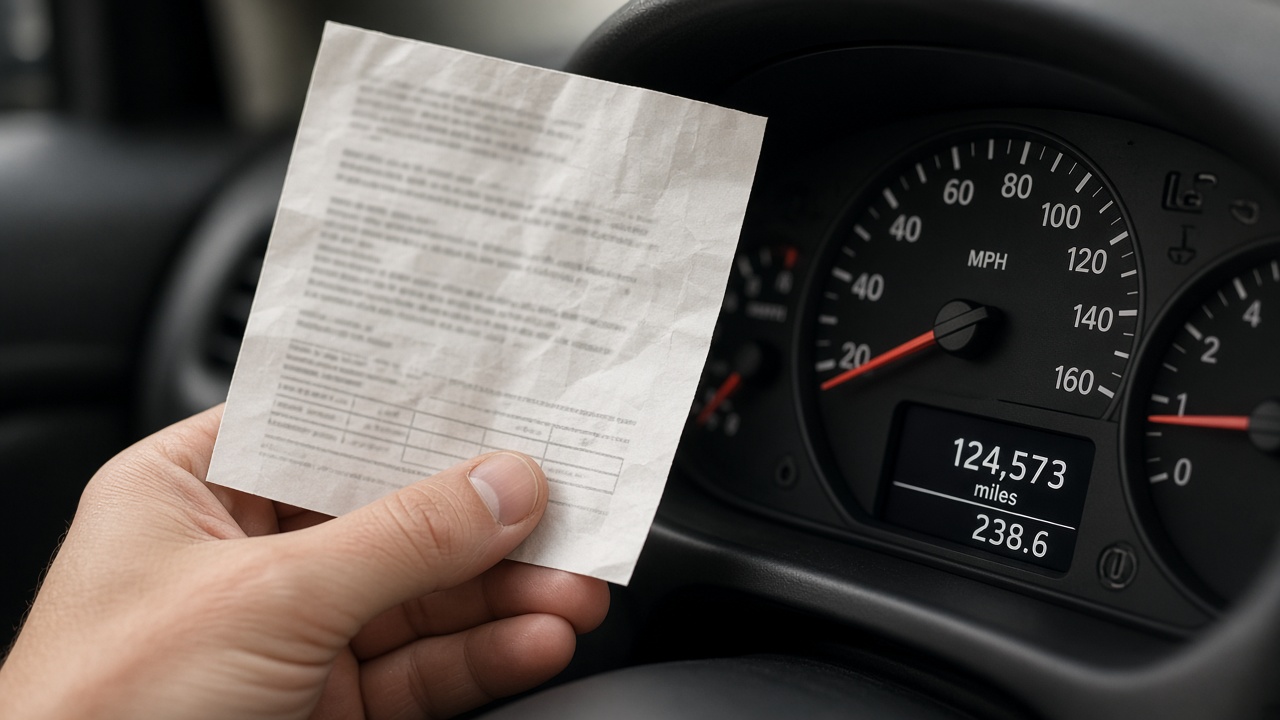
- The MOT history is a public mileage record. Compare every test, not just the latest one, with the mileage you have been told.
- A drop, a stall, or a sudden jump is a reason to stop and ask, not a reason to assume the worst or to ignore it.
- If the record does not make sense, do not retail the car until you know why. Your buyer will check the same page.
Where is the mileage actually recorded?
The advert mileage is whatever the seller typed. The useful record is the MOT history on GOV.UK. Enter the registration and you get each test, the date, the result, the mileage stored for that test, and the advisories.
You do not need an account. Your customer can open the same page after they leave your pitch, so the history has to make sense in one reading.
What does a normal history look like?
Mileage should rise over time. It will not rise in a perfect line: a car can sit, do a school run, or do a motorway commute. What you want is a direction. Each test is higher than the one before, and the gap roughly matches how the car was used.
Write the figures down in date order, oldest first. The latest test should be close to the mileage on the odometer today. A car that has done a few hundred miles since its last test is normal. A car that has somehow done fewer miles than its last test is not.
Which patterns should stop you?
Look for these before you talk yourself into the car.
- A drop. The mileage at a later test is lower than an earlier one. A replacement cluster can cause this, but only if the paperwork says so. If nobody can explain it, walk away or price it as a problem car.
- A long stall. Two tests years apart with almost the same mileage, then a sudden burst. Possible, and also a favourite place to hide a correction. Ask what the car was doing.
- A jump that the car could not have done. A huge gap between tests is not proof of anything by itself. It is a question: was it off the road, or were tests missed?
- A mismatch with the rest of the car. Pedals, wheel, and driver's seat that look more tired than the mileage. The MOT history will not show that. Your eyes will.
What do you do when the numbers disagree?
Do not guess a story that suits the deal. Ask the seller for the service book, invoices, and any note of a replacement instrument cluster. Check that the mileage on those documents sits on the same path as the MOT tests.
If you still cannot explain it, do not put the car in the front line at a normal retail price. Describe the history in writing if you keep it at all. The next buyer will find the GOV.UK page, and they will ask you the question you avoided.
Use the same check on a part exchange and on a private purchase. It takes a minute, and it is the same minute your customer will spend later.
Common questions
Where do I check a car's mileage history?
On GOV.UK, using the registration. The service shows previous MOT tests, the mileage recorded at each one, and the advisories.
Does a lower mileage always mean clocking?
No. A mileometer can be replaced and the new one can start again. The history should still be explainable, and the car's paperwork should mention the change.
Can I sell a car with a mileage discrepancy?
Only if you understand it and you describe it honestly. A retail buyer can check the same MOT history you can.
See what the fees come to on the auction cost calculator, or try the live demo.