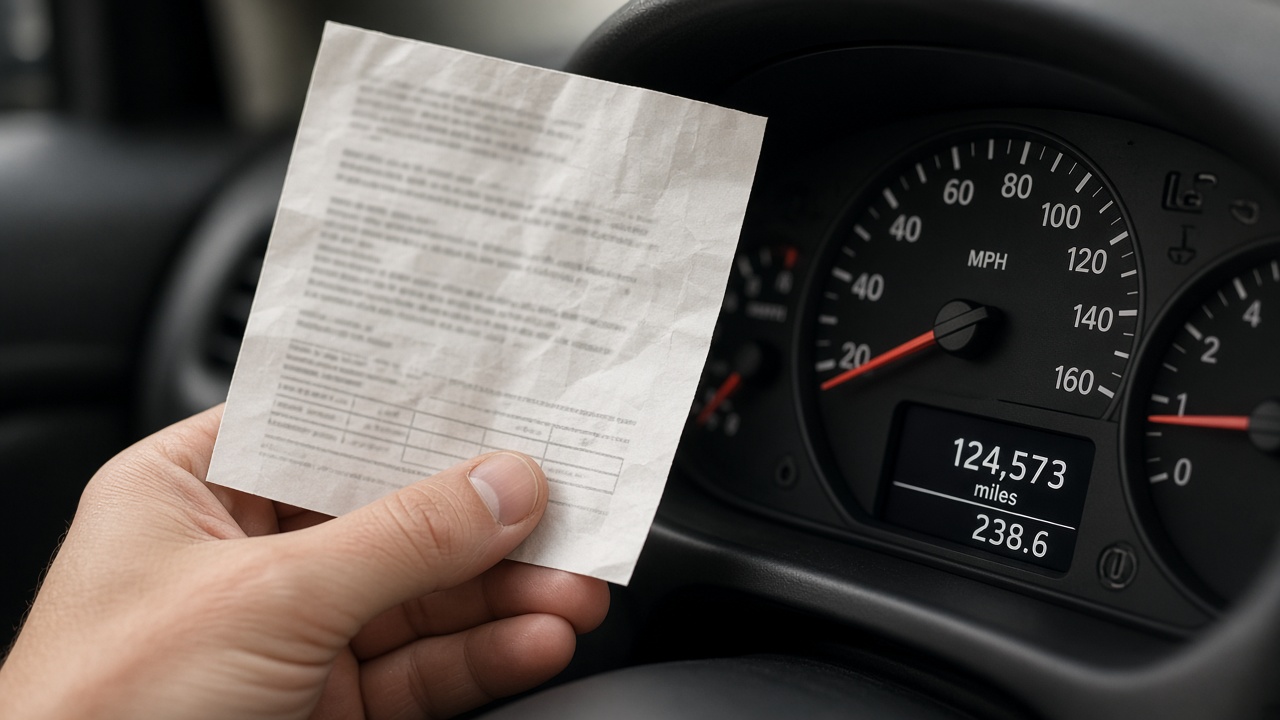
- Full service history means the schedule was followed and you can see the proof. A memory is not proof.
- A missing stamp is not one thing. A gap with invoices either side is a different car from no history at all.
- Read every mileage on the stamps against the MOT history before you let FSH change the price.
Car service history value is the difference a proven record makes when you are buying the car and when you are selling it. Dealers say full service history (FSH) as if it were a sticker. It is a claim. The claim is worth something when the folder matches the car, and worth nothing when it does not.
There is no single sum to add for a stamp. The book already has a view of condition, and your retail price has a view of what local buyers will pay for a story they can check. This is how to read the folder so you do not pay for a phrase.
Where car service history value actually sits
Full service history means the car was serviced in line with the schedule for its age and mileage, and you can see that it was. A stamped book is one kind of evidence. Printed invoices are another. A digital record from a franchised workshop is another. A seller who says "it was done, I just haven't got the book" is not evidence.
The schedule is the manufacturer's, for that model and that year. A car that needed a service every year or every ten thousand miles, and has stamps at those intervals, is the straightforward case. A car on a long-life schedule is judged against that schedule, not against a rule you remember from an older model.
Main dealer stamps are easy to explain to a retail customer. They are not automatically better work. An independent who has put the right oil in and written it down can be the stronger history. Read the invoice. A stamp that does not say what was done is a mark in a box. An invoice that lists the work is a record.
Which gaps move the price
Not every gap is a walk-away. An older car with one missed year, and invoices either side, is a car you price with your eyes open. You might spend the money on the service it skipped, and you say so in the appraisal. You do not pretend the book is full.
A car with no record at all is a different appraisal. You do not know the cambelt, the oil, or whether anyone has been under it. That uncertainty belongs in the price, or in the decision to leave. Hoping the car is fine because it starts is not a history.
A folder that is thick but does not match the mileage is worse than a thin honest one. This is where the MOT history earns its place. Each service should sit on a mileage that fits the MOT readings around that date. A service at sixty thousand when the MOT says forty, or the other way round, is a question you ask before you bid. If the answer is a shrug, the FSH line comes out of your price. You are not buying the phrase. You are buying the proof.
The same reading applies when you are valuing a part exchange. A customer who says full history and hands you a book with two stamps is telling you what they hope. The book is telling you what happened. Price the book.
If you would rather read that folder on your own drive, get your buying site. The history is still your job. The wet car park is the part you can stop chasing.
What to ask for, and what to ignore
Ask for the book or the invoices before you agree a price, not as a surprise at handover. A seller who has them will send them. A seller who needs a week to "find" them is telling you the history is not in the kitchen drawer. You can still buy the car. You buy it as a car without the proof, at a number that reflects that.
Ignore the phrase in the advert. "Full service history" on a listing is the seller's summary. Your job is the pages. Count the intervals against the mileage and the age. A stamp every year on a car that does eight thousand miles a year is a different pattern from a stamp every year on a car that does twenty. The schedule is what the manufacturer asked for. If you do not know it for that model, look it up before you let the folder change your bid. Do not invent a rule from the last car you appraised.
A digital printout with no garage name, no date and no mileage is not a record. An invoice that names the car, the date, the mileage and the work is a record even if the book itself is missing. You can keep copies. You should. The retail customer who asks to see it next month will not be satisfied with your memory of an email.
Service history does not repair a bad mechanical buy. A full book on a car that needs a gearbox is a full book and a gearbox. Price both. The folder is one input. The ramp is another. Dealers who pay up for FSH and skip the inspection have bought a story, not a car.
What you can say when you sell
Write what you can show. If you have a stamped book from new, say so. If you have invoices for the last three services and a gap before that, say that. FSH in the advert, when the folder would embarrass you on a handover, is how a straightforward sale becomes an argument.
Retail buyers are not all experts. Enough of them, or their friend, will look. The ones who look are often the ones who were going to pay a proper price. They will discount a claim they cannot see, and they will trust a description that matches the folder you put on the passenger seat.
Trade value and retail value already sit apart. History is one of the reasons. A trade buyer may shrug at a missing stamp and price the metal. A retail buyer may pay more for a folder they understand. Know which sale you are in before you let FSH change what you bid.
There is no table here of "add this much per stamp". That table would be invented. Look up the car, read the folder, and move your number by what you would have to explain.
If you would rather do that reading on your own drive, with the documents in front of you, get your buying site. The history is still your job. The stranger in a wet car park is the part you can stop chasing.
Common questions
Is a main dealer history always worth more?
It is easier to explain. A full set of invoices from a specialist who actually serviced the car can be the better record. Read the work, not the letterhead.
Should I walk away from a missing stamp?
Walk away when the gap is unexplained and the mileage does not fit. A single missed service on an older car, with the rest in order, is a price conversation.
Do I put FSH in the advert if one stamp is digital?
Put what you can show. If you have invoices, say invoices. Do not write FSH for a story you could not prove to a careful buyer.
See what the fees come to on the auction cost calculator, or try the live demo.